

Where Does a Book Come From?
The winding yet resolved journey of Climate Wayfinding.

I’ve gone a bit quiet the last month. Chalk it up to the final—no, really, the final—ok, the really really final push of getting a book out the door. Climate Wayfinding is now at the printer. I’m exhausted and delighted. And, as I begin the interminable wait to actually hold the thing, I’m reflecting on the rather unusual path of this book.
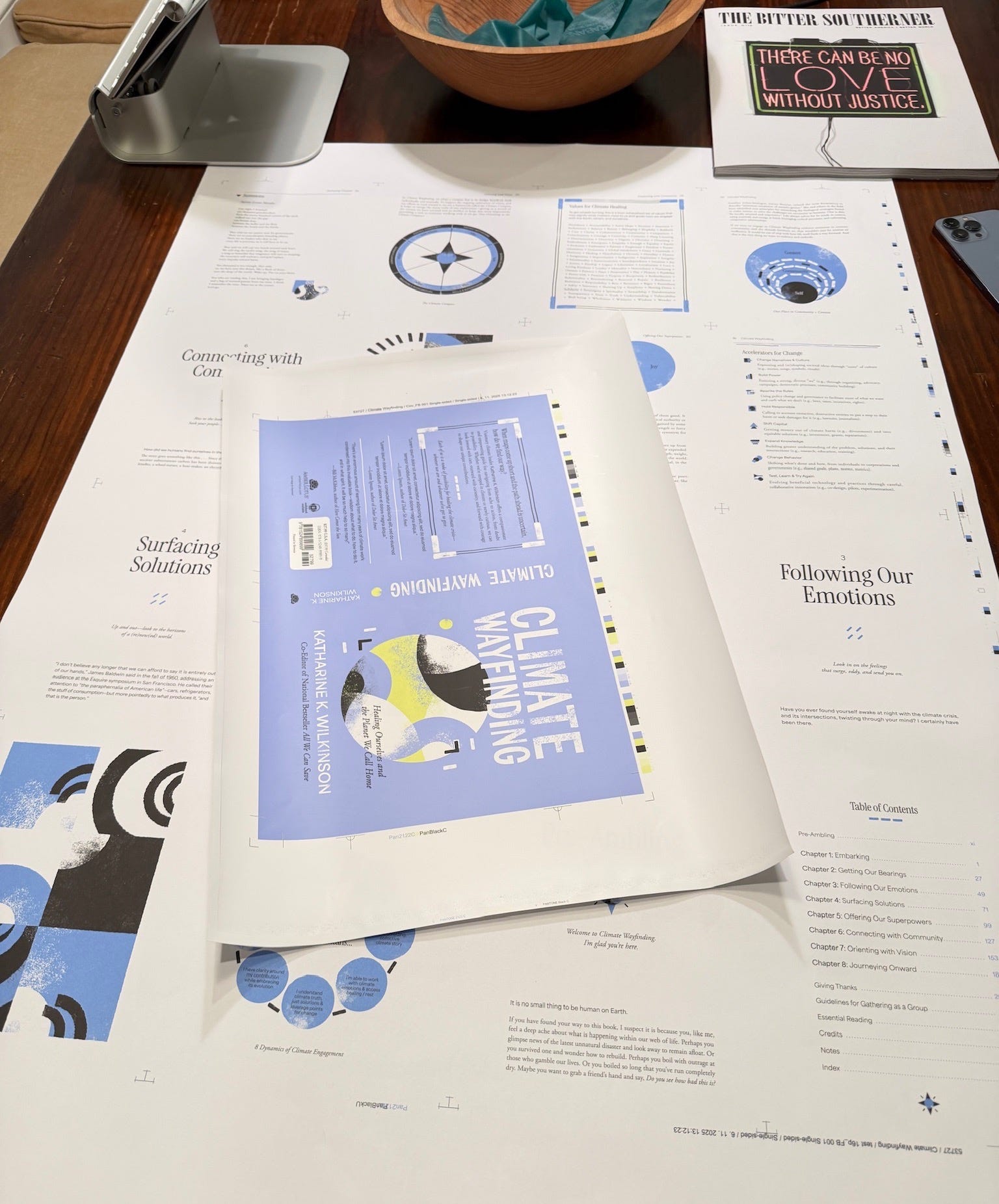
During the hunkered days of 2020, I finally took up The Artist’s Way. Which means I took up morning pages with gusto, and a stack of long-languishing yellow legal pads found their purpose. One morning, my freewriting unspooled a fresh take on the persistent question asked of climate people: What can I do?
It’s a simple question that defies simple answers, yet that’s what people get most of the time: a generic punchlist or suggestions made so plain as to feel cheap. That question, however, is less one we definitively answer than it is one we live with and work with over time. As we do, we may find it’s something of a Russian doll, holding within it many other, bigger wonderings.
What can I do? That question is something of a Russian doll, holding within it many other, bigger wonderings.
So, how had I “lived the question” on my own climate journey from a worried teen to the present freewriting moment? Five steps, it seemed, had helped me figure out how to be of use: feel your feelings, scout your superpowers, survey solutions, consider your context, cultivate a climate squad. Rinse and repeat.
From that scrawl, I shaped a piece for TIME. And then my wheels really got turning… A framework or process on paper is fine, but could those five steps find shape as an experience, as a learning journey? Something to do with the support and spark of others? And given that most people care about climate but most of them are stuck, could this be a generative offering that lots of folks seem to need?
Fast forward through some ideations and design sprints and rounds of feedback…in 2022, The All We Can Save Project (the nonprofit I lead) launched the first pilot cohorts of a new program. We called it “Climate Wayfinding,” honoring the challenge of navigating a world where maps increasingly come up short. By the end of that year, it was clear we were onto something. Participants were describing unlocking, life-giving, and even transformative experiences.
But our tiny team could only shepherd so many people through an experience that intentionally capped out at single-circle size—roughly two dozen—to ensure closeness and connection. Meanwhile, our interest form list continued to grow and grow some more. Could we train and equip others to bring Climate Wayfinding to life in their own communities? Why not try?
Higher education seemed an obvious place to test that notion. An audience of students, often asking big “what’s ahead from here” questions. A mission to help them with said questions. Designated spaces to engage in a collective learning journey—namely classrooms. Educators with ready skills to facilitate it.
We’d train educators experientially. First, they’d go through Climate Wayfinding as participants. (What better way to learn something than to do it? Especially on retreat somewhere magical.) Then, we’d pull back the curtain on the approach. (What exactly happened here, and why did it work?) We’d also equip them with a “toolbox” of beautiful materials: agendas, facilitation notes, slides, assignments, playlists, poetry…the whole kit and caboodle.
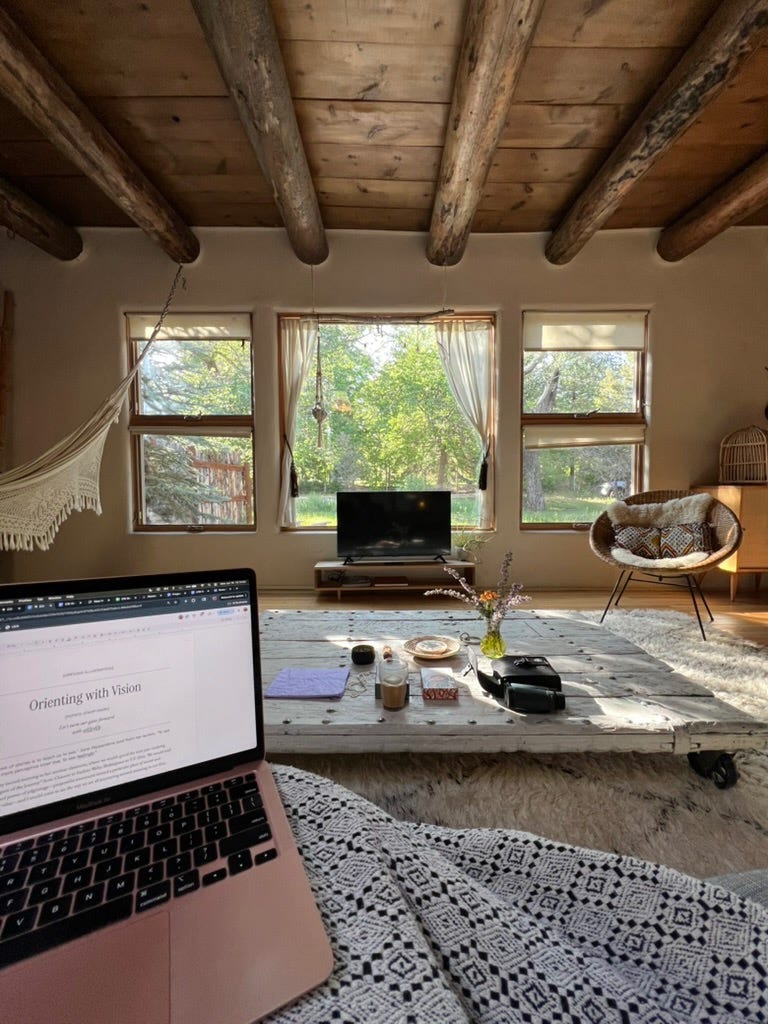
Since I wouldn’t be in the room facilitating these rippled out versions of the program, I thought I’d better write some things down. In the early months of 2024, I penned a series of “orienting essays”—to frame the program overall, the guiding framework we use, and each of the core topics that come to life as a session. Those essays are essential reading for participants.
And then it dawned on me: There’s a book in here. Maybe something like The Artist’s Way for climate? Maybe.
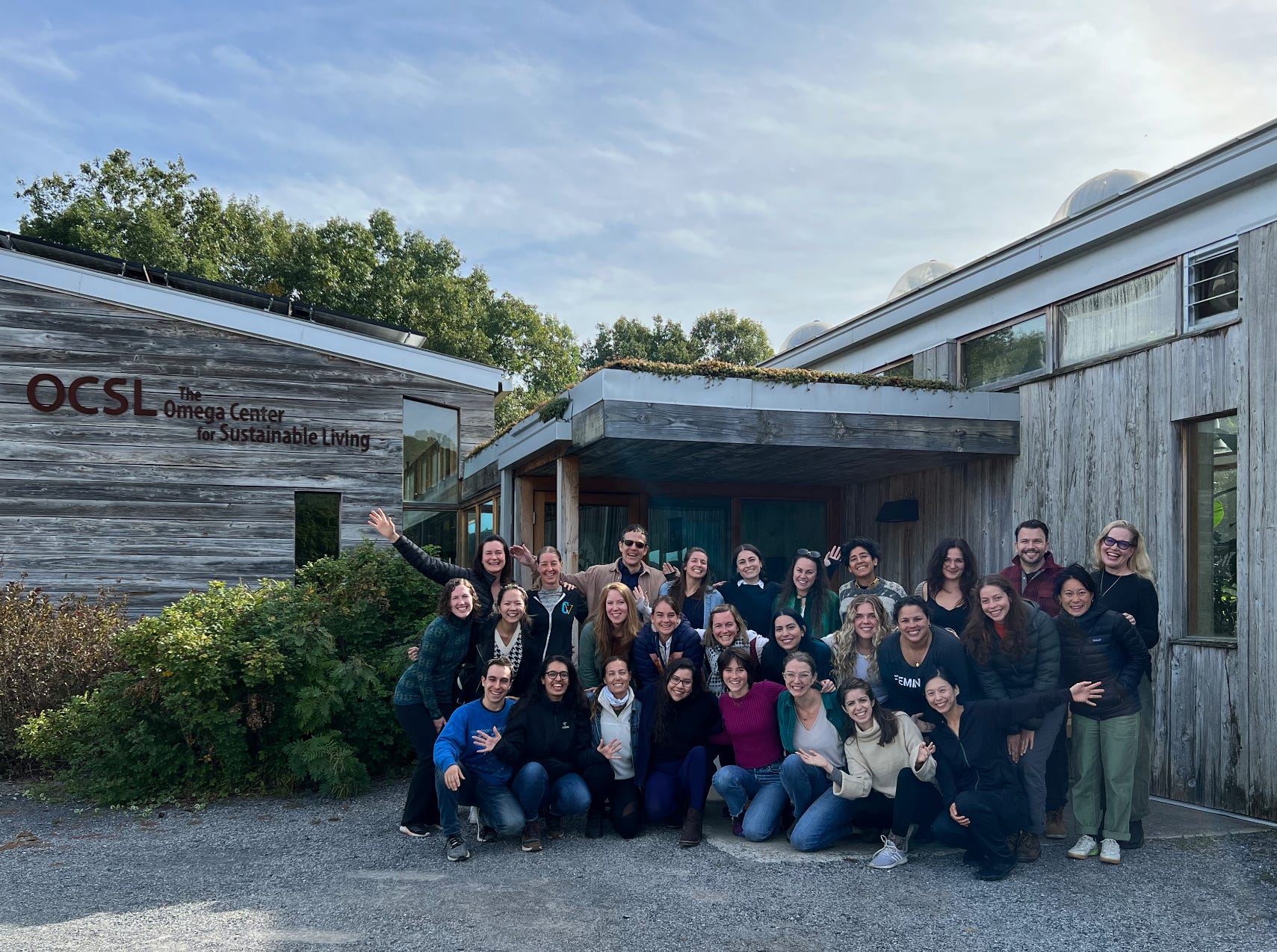
Today, we have 90+ trained facilitators from 75+ colleges and universities. It’s an amazing community of practice, shepherded and supported by our dazzling head of programs, Amy Curtis. We’re in the midst of selecting 100 additional educators to train with us at the Omega Institute in August 2026. They’ll come from higher ed, cultural institutions, community organizations, and beyond.
In just a few months’ time, there will be a Climate Wayfinding book to make facilitating this program even easier and more dynamic. That book will also make the experience available to damn near anyone. Take the journey as a solo reader, engaging with journal prompts, creative exercises, practical frameworks. Take the journey as a self-led group of friends, colleagues, fellow good-troublemakers (à la All We Can Save Circles). More than just a talk-to-you book, it’s also a walk-with-you book.
These past few years, shaping the program and then bringing it to the page, have convinced me: We can find our way from overwhelm to clarity, burnout to renewal, isolation to connection, concern to contribution—even as the world swerves and slips. Indeed, these are the times we need to go deep. All the better if we do so together. (And another piece for another time: We must refuse to let society’s obsession with scale rob us of opportunities for depth and our knowingness of its necessity.)
We can find our way from overwhelm to clarity, burnout to renewal, isolation to connection, concern to contribution—even as the world swerves and slips.
So, where does a book come from? It comes from quiet time for unfettered, aimless writing. It comes from reflecting on one’s own path. It comes from a short piece that nudges for something more. It comes from efforts to make a useful offering to others. From listening to how that’s received and what else is wanted. From a desire to aid our human aches and wonderings, which have much to do with the future of life on this planet.
A book comes from a willingness to take a winding path, but to do so with a sense of resolve. The same is true, it turns out, for a climate journey. Oh, you through lines of being human.
Of course, what’s much more exciting than where a book comes from is where it goes once it lands in the hands of readers. I think it’s fair to say this one can’t wait to be held, marked up, lived with, and, an author hopes, loved well.
Take good care,

P.S. If you’re so moved, preorder Climate Wayfinding here or anywhere you buy books.
P.P.S. If you hold space for climate-centered learning, training as a Climate Wayfinding facilitator might be just the thing for you. Apply through December 11th.

Super delighted to see this thing come into the world! If you make it to Vancouver, I'd love to do an event together :)
Such a bright, shimmering peek behind the scenes. Here we go! 🌬️